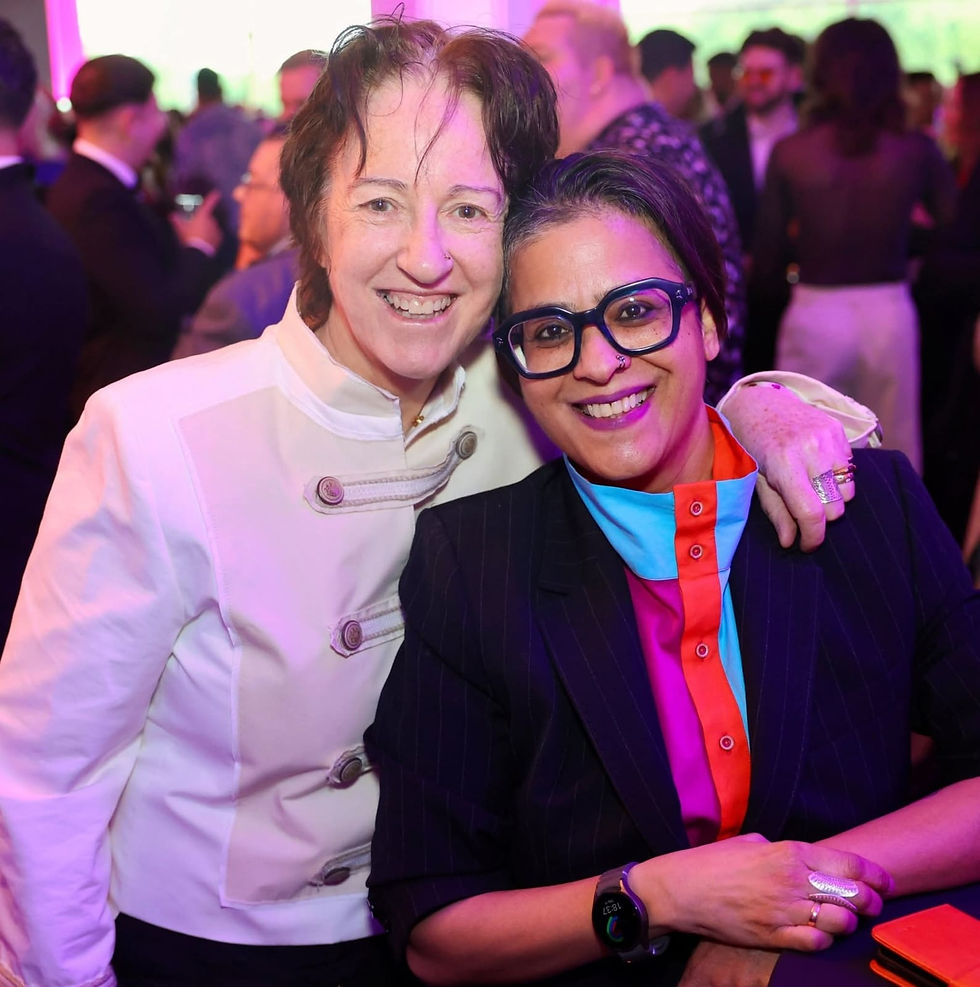
Martina Benvenutto: the voice that transforms a stage into a place of belonging

There is a moment, just before everything begins, in which nothing has yet happened.
The lights are ready. The audience waits. The stage remains silent.
And someone breathes.
For Martina Benvenutto , that moment matters. Before going on stage, she allows herself a few minutes to be silent, review the script, and remember something seemingly simple: it's not about doing it perfectly. It's about being present.
Perhaps that phrase explains his way of understanding communication better than any other.
Martina doesn't see the stage as a place from which to speak to others, but as a space from which to connect with them. A territory where a voice can become a bridge, where a story can spark a conversation, and where emotion can achieve something that words alone cannot: to endure.
From a young age, she found in art a way to express herself freely. Over time, that intuition transformed into a profoundly human way of being in front of an audience, based on sensitivity, closeness, and authenticity.
For the past few years, her voice has accompanied one of the most symbolic moments of ELLA Festival Mallorca : the opening ceremony. That instant when the festival ceases to be a program, a date, or a place and begins to transform into a shared experience.
Saying welcome might seem like a simple gesture. But making someone feel truly welcome is another matter entirely.
It involves looking beyond the stage. Understanding who is listening. Creating a space where different stories, identities, and ways of life can meet without needing to explain themselves.
For Martina, that's also where the power of art lies: in making visible what has remained out of focus for too long, in questioning prejudices, and in allowing someone to recognize themselves, perhaps for the first time, in what is in front of them.
We talked to her about the stage and what happens before stepping onto it, about emotion, identity and representation; about the stories that still need to be heard and about that mysterious connection that appears when a person expresses themselves from a true place and, on the other side, someone feels that those words also belong to them.

How did your journey in the art world begin? What led you to connect with the stage and communication as a form of expression?
From a very young age, I felt that art was the place where I could express myself most freely. I was always drawn to creativity, aesthetics, and people. Over time, I discovered that the stage wasn't just a place to speak, but a space to connect, evoke emotions, and build bridges between those who tell stories and those who hear them.
How would you define your artistic language? What do you try to convey when you're on stage?
I would define it as a very human language. I like to communicate with sensitivity, warmth, and authenticity. When I'm on stage, I try to make people feel part of what's happening, not just attend an event, but experience it.
Where does your inspiration come from? What role does emotion play in your work?
My inspiration comes from people, conversations, art in all its forms, and life stories. Emotion is at the heart of everything I do. I believe that when something evokes emotion, it stays in the memory.
You've been the presenter of ELLA's opening for the past few years, how do you experience that moment from the inside? What does it mean to you to open a space like ELLA through your voice?
It's a privilege and also a great responsibility. ELLA represents a space of freedom, diversity, and culture, and being able to welcome everyone to the festival each year is an honor. I try to ensure my words convey precisely that: that everyone feels welcome and part of a community that celebrates authenticity.
How do you prepare for that moment? Is there any ritual or special thing you do before going on stage?
I always take a few minutes to be silent. I review the script, take deep breaths, and remind myself that what's important isn't perfection, but being present. When I go on stage, I try to enjoy the moment and connect with the audience naturally.
Do you believe art can generate social change? In what way? What responsibility do you feel as an artist in the spaces you inhabit?
I am convinced that art has the power to spark conversations, challenge prejudices, and bring to light realities that often remain invisible. As an artist and communicator, I feel a responsibility to contribute to creating spaces where everyone can feel represented and heard.

What kind of stories do you think still need more space within the culture?
All those stories that have long been overlooked. Diverse, courageous, and real stories, told with respect and humanity. Culture is so much richer when it incorporates different perspectives and experiences.
How does your identity interact with your artistic expression? Do you feel that your presence on stage has an impact beyond the artistic moment?
My identity is part of who I am and, therefore, also of how I communicate. I've never wanted it to define all my work, but neither have I wanted to hide it. If my presence can help someone feel understood, understood, or see new possibilities for themselves, then the stage transcends the artistic moment and becomes a space for representation as well.
What makes ELLA special to you as an artist? What kind of connection is created with the audience in this space?
ELLA has something very hard to find: it brings together culture, art, and diversity from an authentic place. A very sincere connection is created with the public because there is a sense of freedom and respect that invites people to be themselves.
Has there been a moment on stage that has particularly stood out for you? When do you feel that everything makes sense?
There are many moments I remember fondly, but the most special are those where you see the emotion in the audience. A look, a heartfelt round of applause, or a conversation after the event can be worth far more than any award. That's when I feel it all makes sense.
What would you say to someone who wants to express themselves but doesn't yet dare?
I would tell him not to wait until he feels ready, because that moment will probably never come. We all feel fear sometimes. The important thing is to take the first step and be true to yourself. When you express yourself from a place of truth, you always find people who connect with that authenticity.

When being present is enough
After speaking with Martina, one phrase remains:
“The important thing is not to do it perfectly, but to be present.”
It could simply be a reflection on the stage. On controlling your nerves, breathing, and letting the words find their place.
But perhaps it also speaks of something much bigger.
We spend a good part of our lives waiting to feel ready.
Ready to speak. To take up space. To show who we are. To dare.
And, while we wait, we run the risk of confusing safety with the absence of fear, when many times courage consists precisely in doing something while the fear is still there.
Martina speaks of art as a space capable of opening conversations and bringing closer realities that had remained invisible. She speaks of identity without turning it into a label. Of representation without the need for grand pronouncements. Of that seemingly small but profoundly powerful possibility of someone seeing another person being fully themselves and understanding that perhaps there is also a place for them.
That's why her work at ELLA transcends the role of someone who presents an event.
An opening marks the beginning of a festival, yes. But it can also mark the moment when someone who arrived without knowing anyone looks around and begins to feel part of something.
And that doesn't just happen with lights, music, or speeches.
It happens in the details.
In a glance that meets another. In a word spoken at the right moment. In applause born not of courtesy, but of emotion. In a conversation that continues when the stage is already empty.
It is precisely those moments that Martina says she cherishes most. Because in them, the distance between the speaker and the listener disappears. And what remains is something much simpler: two people who, for a moment, have truly connected.
This year that moment before will exist again.
The stage will be set. The audience will wait. For a few minutes, before going on, Martina will remain silent.
He will breathe.
And then he will pronounce the first words.
Perhaps that is one of the most beautiful ways to understand what it means to open ELLA: not simply to inaugurate a festival, but to open a space where other people can feel free to occupy their own.
Without having to be perfect.
Without having to ask for permission.
Simply present.